
TL;DR
Building your own AI workstation used to be cheaper, but supply shortages and price spikes mean prebuilt systems often match or beat DIY costs today. Choose based on your need for control, support, and speed to deployment, not just price.
Imagine unboxing a machine ready to run, with everything calibrated for your AI workload. That’s what a prebuilt AI workstation offers—speed, reliability, and support. But building your own can still sound appealing, especially if you crave maximum control or a custom touch.
Here’s the twist: in 2026, the old rule — build cheaper, buy faster — no longer holds true. Supply chain issues and market shifts mean that sometimes, buying a prebuilt saves money and headaches. This article breaks down the real tradeoffs, so you can pick the right route for your AI projects.
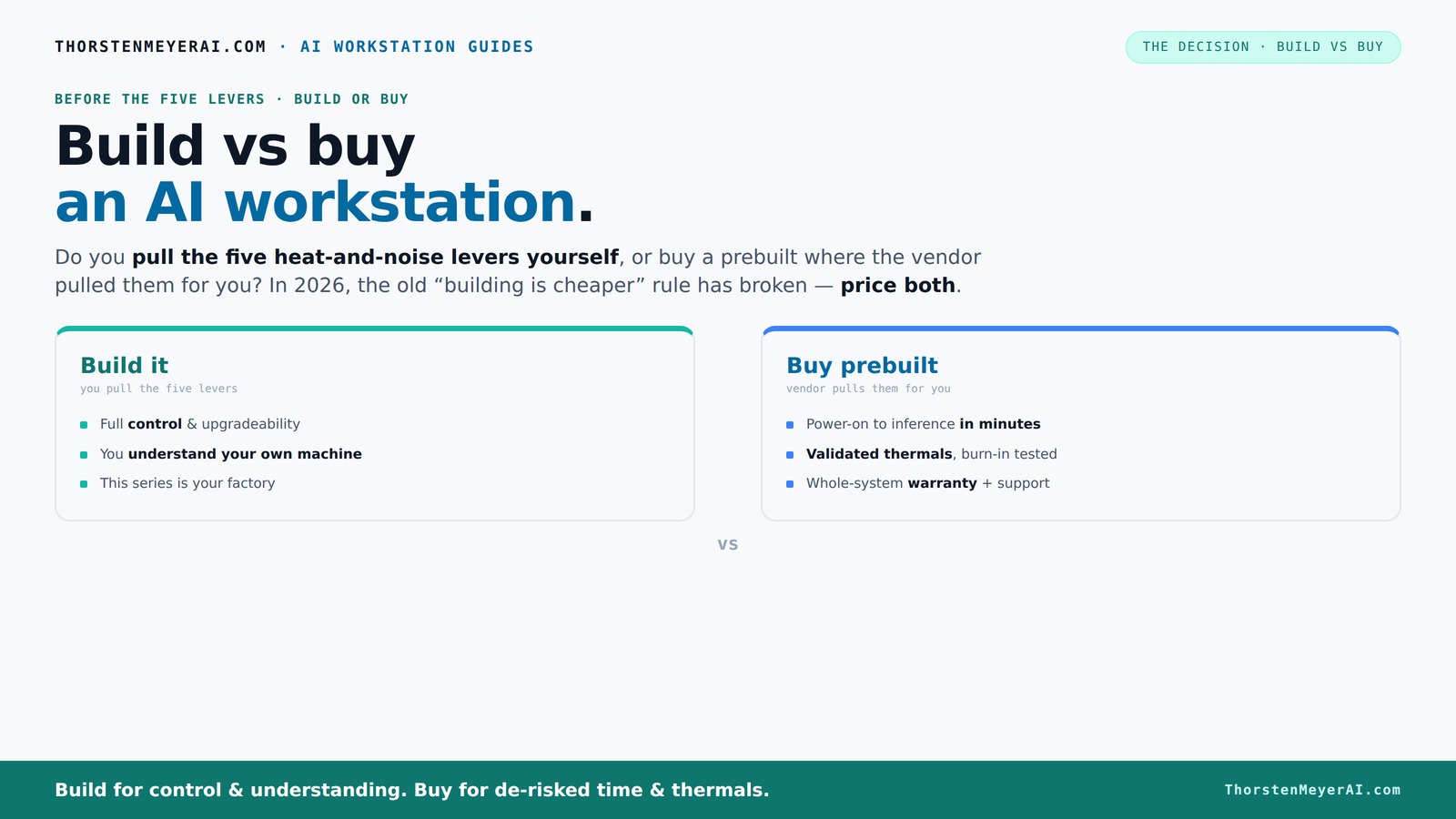
Build vs buy
an AI workstation.
The real question behind this whole series: do you pull the five heat-and-noise levers yourself, or buy a prebuilt where the vendor pulled them for you? And in 2026, the old “building is cheaper” rule has broken. Match your situation in Part 3.
Key Takeaways
- In 2026, component shortages and bulk discounts make prebuilt AI workstations often as affordable as DIY setups.
- Support, warranty, and validated thermals are key benefits of prebuilt systems—crucial for reliable AI training.
- Building offers maximum control and upgrade potential, but requires thermal expertise and time investment.
- For quick deployment and minimal hassle, prebuilt rigs save days of setup and troubleshooting.
- Evaluate your workload pattern: sustained tasks favor local systems; bursty workloads may lean toward cloud.
Toughbuilt C550-2 TB-C550-2 Sägebock, schwarz
- Material: 100% Stahl with Power Coating
- Quantity: Set of 2 (Pair)
- Use Case: Ideal for home projects
As an affiliate, we earn on qualifying purchases.
As an affiliate, we earn on qualifying purchases.
What Does an AI Workstation Actually Entail?
An AI workstation is a high-powered computer packed with GPUs, fast storage, and cooling designed to handle heavy machine learning tasks. Think of it as a dedicated deep learning farm—big, noisy, and built for performance. For example, a machine with 2-4 high-end GPUs like the RTX 4090 or A100 can chew through datasets faster than cloud options for sustained workloads. Learn more about AI hardware.
This isn’t just a beefed-up gaming PC. It’s about stability, thermal management, and having the right hardware to run models like GPT-3 or stable diffusion without hiccups. Your choice of components—GPU memory, power supply, cooling—directly impacts performance and longevity.

Greed® MK2 Pro - High End Gaming PC - AMD Ryzen 7 5700X + Nvidia Geforce RTX 5070 12 GB - Schneller RGB Computer + 4K Rechner mit 4,6 GHZ - 32 GB DDR4 RAM - Wasserkühlung - 1TB SSD - WLAN + W11 Pro
- Made in Austria: Handcrafted by Austrian IT experts
- Premium Design: Futuristic case with RGB lighting
- Powerful Components: RTX 5070 12GB, Ryzen 7 5700X, 32GB RAM
As an affiliate, we earn on qualifying purchases.
As an affiliate, we earn on qualifying purchases.
Build or Buy? How to Decide Based on Your Goals
Choosing between building and buying hinges on what you value most: control, speed, cost, or support. Do you want full control over hardware choices, cooling, and upgrades? Or do you prefer something ready to go with minimal fuss? Explore home improvement and tech tips.
Here’s a quick checklist:
- Control & Customization: Building gives you precise hardware choices and tweakability, allowing you to tailor the system exactly to your needs. This can be crucial if your workload demands specific hardware configurations or if you enjoy the learning process. However, it also means you’re responsible for troubleshooting and optimizing thermal performance. The tradeoff here is between having the ability to fine-tune every detail versus the time and expertise required to do so. If you’re comfortable with hardware tinkering, building can offer a sense of ownership and potential savings in the long run. But if you lack experience, it might lead to thermal issues or compatibility headaches, which could negate the cost benefits.
- Time & Convenience: Buying prebuilt means plug-and-play, with support and validation baked in. This reduces setup time significantly and minimizes the risk of compatibility issues or thermal problems that can plague DIY builds, especially if you’re not experienced in fine-tuning hardware. The convenience often translates into faster deployment, which can be critical for business timelines or urgent projects. However, this comes at a premium, and some flexibility in hardware choices might be sacrificed.
- Cost: In 2026, prices are close enough that actual component costs and bulk discounts tip the scale. While DIY might seem cheaper upfront, the additional time spent troubleshooting, sourcing parts, and potential thermal tuning can offset cost savings. Conversely, prebuilt systems often include support, warranties, and optimized configurations that can save money and hassle in the long run. The key is understanding that the true cost isn’t just the sticker price but also the value of your time, effort, and the risk of system downtime.
In essence, it’s a trade-off: DIY for maximum flexibility, customization, and learning; prebuilt for speed, reliability, and peace of mind. Your choice should align with your technical skill, timeline, and whether you prioritize control or convenience.
professional AI workstation build kit
As an affiliate, we earn on qualifying purchases.
As an affiliate, we earn on qualifying purchases.
How Much Does It Cost Today? Build vs Prebuilt in 2026
Cost is no longer a clear-cut win for DIY. A typical custom build with high-end GPUs, DDR5 RAM, and fast SSDs used to cost around $1,000. Now, shortages and demand push that to $1,250 or more. The rising costs reflect not only the hardware scarcity but also the increased importance of thermal management and power supplies that can handle the latest components reliably. Meanwhile, prebuilt systems from vendors like Lambda or BIZON often match, or even beat, these prices thanks to bulk buying, streamlined assembly, and optimized configurations — sometimes including support and warranties that would cost extra if you assembled yourself.
This shift means that the traditional advantage of building your own system—cost savings—has narrowed or disappeared. When evaluating costs, it’s important to consider the total cost of ownership, including support, warranty, setup time, and potential troubleshooting. For example, a prebuilt system with a three-year warranty and support might cost slightly more upfront but could save you hours or days of troubleshooting, which has real value. Additionally, the time spent sourcing parts, assembling, and fine-tuning can be substantial, especially if issues arise later, making prebuilt options more appealing for those who value time over initial savings.
Here’s a simplified comparison:
| Component/Feature | Build Cost | Prebuilt Cost |
|---|---|---|
| GPU (RTX 4090 or A100) | $1,200 | $1,150 |
| CPU, RAM, Storage | $500 | $600 |
| Case, Cooling, Power Supply | $300 | Included in prebuilt |
| Labor, OS, assembly | $0 (DIY) | $200–$500 (support, assembly) |
Factoring in support, warranty, and setup time, prebuilt can sometimes be cheaper or at least on par with DIY today. The key is to evaluate your specific needs and consider not just the initial hardware costs but also the value of support and time savings. For instance, a prebuilt with a three-year warranty and on-site support might be worth the extra $200 compared to a DIY build that requires you to troubleshoot issues on your own. In the end, the decision hinges on weighing the value of your time and peace of mind against the initial cost savings of a DIY approach.

Leap Frog Imagination Desk Pre-k Math Games
- Educational Math Games: Pre-kindergarten math activities
As an affiliate, we earn on qualifying purchases.
As an affiliate, we earn on qualifying purchases.
Performance & Reliability: Which Lasts Longer and Runs Cooler?
Performance isn’t just about raw power; it's about stability over time. Prebuilt systems are tested extensively—often 24–48 hours of burn-in—to ensure they won’t throttle under load. For example, a vendor like Puget runs every system under sustained GPU load before shipping, guaranteeing thermal stability and consistent performance. This thorough validation is crucial because thermal issues are a leading cause of system failures and performance drops during intensive workloads. When a system is tested extensively, it’s more likely to maintain peak performance over time, reducing the risk of thermal throttling, hardware failures, or unexpected shutdowns that can disrupt training and cost money.
Building your own gives you control but demands expertise. If cooling setup isn’t perfect, your machine might run hotter or louder, reducing component lifespan and increasing noise pollution. For example, an improperly configured airflow can cause GPU temperatures to spike, leading to thermal throttling and reduced performance. Conversely, a well-designed custom cooling solution—such as high-quality fans, liquid cooling, and optimized airflow—can outperform prebuilt systems in thermal management, but only if you understand thermal dynamics. Consider a scenario where you undervolt the GPU and optimize airflow—this can cut noise and heat by up to 30%, but only if you know what you’re doing. Proper thermal tuning can extend hardware lifespan and ensure consistent performance, which is vital for long-term AI projects. Check out this guide for tips on thermal tuning.
In the end, prebuilt systems often outperform DIY rigs in consistent thermal management thanks to professional validation, which translates into longer component lifespan and more reliable operation over time. This reliability reduces downtime, ensuring your AI training continues smoothly and cost-effectively over the long haul.
Support, Warranty, and Peace of Mind
When your AI training runs into trouble—crashes, driver issues, or hardware failures—support matters. Prebuilt vendors typically bundle multi-year warranties, on-site RMA, and dedicated support lines. For example, BIZON offers up to 5 years of support, which can save you from costly downtime and the frustration of troubleshooting hardware issues on your own. Having access to expert technicians who understand the system’s design can significantly reduce downtime and help you maintain productivity, especially if your workload is mission-critical. This support network is especially valuable because AI workloads are often complex, and hardware issues can be time-consuming to diagnose and repair without proper expertise.
If you build your own, support is fragmented. Troubleshooting driver conflicts or cooling issues can take hours or days, especially if you’re new to thermal tuning or BIOS settings. Plus, warranties are limited to individual parts, not the entire system, meaning you might have to coordinate multiple warranties and repairs. This can lead to longer downtime and increased costs if multiple components fail simultaneously. Therefore, for users who depend on consistent uptime and minimal hassle, a prebuilt with validated thermals and comprehensive support can be a crucial advantage, ensuring your projects stay on track without unnecessary delays.
Future-Proofing and Upgradability: Can Your Machine Grow With You?
Building gives you a clear upgrade path—swap out GPUs, add more RAM, or tune cooling as needed. Think of it as a machine you can tinker with over the years. For instance, choosing a high-quality power supply and a spacious case means you can add another GPU later, or upgrade to faster storage without replacing the entire system. This flexibility allows you to adapt to evolving AI workloads and hardware advancements, potentially extending the lifespan of your investment. The ability to upgrade also means you can respond to software demands, such as needing more GPU memory or faster CPUs, without starting from scratch. This is especially important as models and datasets grow larger, requiring more powerful hardware over time.
Prebuilt systems are often less flexible. Vendors might limit upgrade options or require specific components, which can restrict future expansion. However, some vendors like Lambda design their rigs with future expansion in mind, providing accessible slots and high-capacity power supplies to facilitate upgrades. Still, these systems may come at a premium and might be less customizable than a self-built machine. When considering future-proofing, evaluate whether the system’s design allows for easy upgrades and whether the initial cost aligns with your long-term plans. Building your own gives you maximum control over this aspect, but prebuilt options are increasingly offering modular designs to address this need.
In either case, consider your long-term needs. Will you need more GPU memory for larger models? Faster CPUs as software advances? Building might be better if you value customization and future-proofing, but prebuilt options are improving in this regard. Evaluate your anticipated workload growth and plan accordingly to ensure your investment remains relevant for years to come.
Which User Types Benefit Most from Building or Buying?
If you’re a hobbyist, student, or researcher with time and a passion for hardware, building your own system offers learning and customization. You’ll get hands-on experience tuning your hardware for maximum performance, which can deepen your understanding of system architecture and thermal management. Additionally, if you’re comfortable troubleshooting and sourcing parts, building can be more cost-effective and tailored to your specific needs. However, this approach requires patience and technical skill, and the time investment can be significant. The tradeoff is that you gain a deeper understanding of hardware, which can be valuable for troubleshooting future issues or customizing systems for specialized tasks.
For professionals or teams where time is money, prebuilt systems cut setup time dramatically. They come with validated thermals, support, and warranty—crucial for 24/7 training or deployment. Think of a startup with a tight deadline: buying prebuilt can get you running faster, minimizing downtime and allowing you to focus on your core work. This approach reduces the complexity of hardware management, letting you concentrate on model development or deployment without being distracted by hardware issues. Hybrid options are also emerging—some vendors offer custom configs with support, giving a middle ground that combines tailored hardware with professional validation and support. This can be ideal for those who want some level of customization without sacrificing reliability or support.
When Does Cloud Make More Sense Than a Local System?
Cloud remains attractive if your workloads are bursty or unpredictable. For example, training a large model for a few days, then shutting down, might be cheaper in the cloud because you pay only for what you use. Cloud providers like AWS, Azure, or Google Cloud offer on-demand GPU clusters that can be scaled up or down quickly, providing flexibility that local systems can’t match. However, for prolonged, continuous workloads, cloud costs can accumulate rapidly, making local hardware more economical over time. The decision hinges on workload characteristics—if your tasks are sporadic or require rapid scalability, cloud offers a flexible, pay-as-you-go model. But if you have steady, long-term projects, investing in a local system can be more cost-effective and provide greater control over data and security.
According to recent data, for sustained workloads, a local machine can be 2-3 times cheaper than cloud over a year, once hardware costs are amortized. Cloud also offers the advantage of avoiding upfront investment and hardware obsolescence, which can be appealing for experimental or short-term projects. The key tradeoff is control: with cloud, you relinquish some control over data locality, security, and customization, but gain flexibility and rapid provisioning. Your choice depends on your project’s scale, data security needs, and whether you value immediate access or long-term cost savings.
Ultimately, it’s about your project’s scale, duration, and whether you value the immediacy and control of local hardware or the scalability and convenience of the cloud. For ongoing, intensive workloads, investing in local hardware often yields better long-term value, while for sporadic or exploratory tasks, cloud can be more cost-effective and less burdensome.
Frequently Asked Questions
Is it cheaper to build or buy an AI workstation in 2026?
It depends on your specific configuration and current market prices. Thanks to supply shortages, prebuilts often match or beat DIY costs today, especially when you factor in support and time saved. Always compare prices for your exact setup before deciding.
Which option offers better performance for training large models?
Both can deliver high performance. Prebuilts are validated for thermal stability and often come with optimized cooling, which supports sustained workloads. Building your own can match or surpass this with proper thermal tuning, but requires expertise. The key is that prebuilt systems often undergo rigorous testing, which reduces the risk of thermal throttling and hardware failures during intensive tasks, ensuring consistent performance over long training sessions. DIY setups, while potentially more customizable, depend heavily on your thermal management skills and component choices, which can impact reliability and performance stability. This validation and testing process in prebuilts often results in more reliable, stable performance during continuous heavy workloads, which is critical for long-term AI training projects.
How much GPU memory do I need for AI work?
For training large models, 24–48 GB of GPU memory is ideal. This allows handling bigger datasets and models without frequent swapping or memory errors. Smaller projects or inference tasks may be feasible with 8–16 GB. The choice depends on your specific workload and model size. Investing in higher memory GPUs can also future-proof your setup as models grow in complexity. Larger memory GPUs reduce the need for complex data sharding and enable training of bigger, more sophisticated models without performance bottlenecks, which is essential for staying at the forefront of AI research and deployment.
Are prebuilt workstations reliable enough for 24/7 training?
Yes, if purchased from reputable vendors like Lambda or BIZON. They rigorously test their systems, often running extended burn-in cycles to ensure thermal stability and hardware durability. These validations help prevent thermal throttling or hardware failures during continuous operation. This reliability is crucial for mission-critical AI training, where downtime can be costly and disruptive. While DIY systems can achieve similar reliability, they require careful thermal management, extensive testing, and expertise. The professional validation and support that come with prebuilt systems significantly reduce the risk of unexpected failures, providing peace of mind and consistent performance during long-term, intensive workloads.
What do I lose by not building my own system?
You sacrifice some control over hardware choices, cooling configurations, and future upgrade paths. Support and warranty coverage might also be less comprehensive if you assemble the system yourself, requiring you to troubleshoot issues independently. However, you gain time, convenience, and often a more reliable thermal setup from professional validation. This trade-off means you can focus more on your core work without the hassle of system tuning and hardware compatibility concerns. Additionally, you miss out on the deep hardware understanding and customization opportunities that come with building your own system, which can be valuable for troubleshooting or tailoring the system to very specific workloads. Ultimately, it’s a balance between control and convenience, with the professional support and validation of prebuilts often outweighing the benefits of DIY for most users.
Conclusion
Choosing between build and buy in 2026 isn’t just about cost — it’s about what you prioritize: control, speed, support, or flexibility. With market shifts making prebuilts more competitive, your decision should hinge on your specific needs and how much time you want to spend tuning or troubleshooting.
Imagine a machine running smoothly, quietly, and ready when you are—whether you built it or bought it. That’s the real goal. Now, step back, price both options, and pick what fits best—your future AI projects will thank you.