
TL;DR
A House Beautiful report, citing professional organizers, challenges two familiar decluttering rules: remove an item whenever you buy something new, and discard clothes not worn in a year. The organizers say regular clear-outs, available storage space and whether clothes suit someone’s life are more useful guides. Their advice is professional opinion, not a universal standard.
A House Beautiful report citing professional organizers says households can set aside two familiar decluttering rules: getting rid of one item every time a new one comes in, and discarding clothes that have not been worn in a year. The organizers argue that regular clear-outs, functional storage and individual needs are more useful guides than strict deadlines or purchase-by-purchase purges.
The first rule, often called “one in, one out,” asks people to remove an existing possession each time they bring home a new one. Organizers Kenika Williams, founder of Tidied by K., and Jayna Lattimore, founder of Ordered Professional Organizing, told House Beautiful that following this rule after every purchase can be unnecessarily rigid. Williams said people do not need to treat each purchase as a signal to purge. Lattimore said regular sweeps can help households remove things they no longer use without tying the task to buying something new.
Their alternative is to think about where an item will live before bringing it home and to keep storage systems from being packed to capacity. Williams said a new purchase should have a “natural, intuitive, and functional home.” Lattimore said organization should leave some room for growth, so that a household can accommodate occasional additions without making its systems harder to maintain.
The second rule advises letting go of any clothing that has not been worn in the past year. Millie Naor, founder of Bella Organizers, told the publication that some rarely worn items may still be worth keeping if they are special, provided their number is limited. Beth Ruck, founder of Conquering Clutter, said a time limit alone is not the best way to decide. She recommends considering whether an item works with other clothes and supports the owner’s current lifestyle.
Rethinking Purges and Closet Deadlines
The advice matters because strict rules can make organizing feel like a series of immediate tests: every purchase requires a sacrifice, and every unworn garment faces a fixed deadline. The organizers quoted by House Beautiful instead describe decluttering as an ongoing household routine, guided by space, usefulness and personal priorities.
That approach may be more manageable for people whose clothing needs vary by season, work, health or occasion. It also avoids treating an item’s recent use as the only measure of its value. But the report does not establish that one approach works for everyone. A household with limited storage, for example, may still choose a stricter limit; the central point is that the rules are optional tools, not requirements.

SONGMICS Regalsystem, Set aus 16 Würfeln, Kleiderschrank, Kunststoff
- Secure Doors with Internal Hooks: Doors stay firmly closed with internal hooks
- Sturdy Metal Frame: Supports up to 4.5 kg per shelf
- Includes Safety Tipping Protection: Provides additional stability and safety
As an affiliate, we earn on qualifying purchases.
As an affiliate, we earn on qualifying purchases.
The Rules Under Review
The two sayings are presented in the report as common organizing advice, rather than as formal standards or rules backed by a single authority. The first aims to prevent possessions from accumulating by pairing each incoming item with one outgoing item. The second uses a year without wear as a simple test for whether clothing is still needed.
The organizers’ objections are about applying those tests mechanically. Williams allows that one-in, one-out may work for someone who likes it. Lattimore’s suggested alternative is to conduct regular sweeps during the year. On clothing, Naor and Ruck recommend weighing the purpose and importance of an item rather than relying on a calendar alone. The source does not report a study comparing these methods or quantify their effects.
“I don’t think every purchase needs to trigger a purge.”
— Kenika Williams, founder of Tidied by K., quoted by House Beautiful

Lifewit 3 Stück 35L Aufbewahrungstasche, Unterbett Aufbewahrungsbox Kleideraufbewahrung, Faltbare Umzugskartons mit Klarem Fenster für Bettdecken Kleidung Decke T-Shirts Kleiderschrank, Grau
- Portable Design: Doppelseitige Griffe für einfache Tragbarkeit
- Space-Saving: Faltbares Design spart Platz
- Transparent Window: Einblick in den Inhalt
As an affiliate, we earn on qualifying purchases.
As an affiliate, we earn on qualifying purchases.
Advice, Not a Universal Test
The report presents organizers’ professional opinions, not research proving that these rules are outdated for every household. It does not provide a survey, data on how widely the advice is used, or a direct comparison of outcomes from different decluttering methods. The source also does not set a recommended schedule for regular sweeps or define how much storage capacity to leave open.
Whether a rarely worn item deserves space is left to the individual. The organizers’ comments offer questions and considerations, but they do not specify a universal number of special garments to keep or a single measure of what counts as useful. The report’s main qualification is that people may continue using either rule if it works for them.

Amazon Basics Ausziehbarer Offener Kleiderschrank mit 10 Höhenverstellbaren Einlegeböden – Maximalgewicht 521 kg, Schwarz, 144.8 – 203.2 x 35.6 x 182.9 cm
- Material: Stabile verchromte Metalldrahtkonstruktion
- Max Weight Capacity: Each shelf supports up to 45 kg
- Adjustable Width: Extends from 145 to 203 cm
As an affiliate, we earn on qualifying purchases.
As an affiliate, we earn on qualifying purchases.
Choosing a Routine That Fits
The report does not announce a new standard or a follow-up policy; it offers readers criteria to apply at home. People considering a new purchase can first ask whether there is a practical place to store it. Those reviewing a closet can consider how a garment fits with other clothes, whether it suits their current life and whether it is meaningful enough to justify the space.
For households that want to try the organizers’ alternative, the next step is to set a recurring time to review belongings rather than waiting for a purchase or a one-year deadline. How often to do that, and whether to keep any parts of the two rules, remains a personal decision based on available space and individual needs.
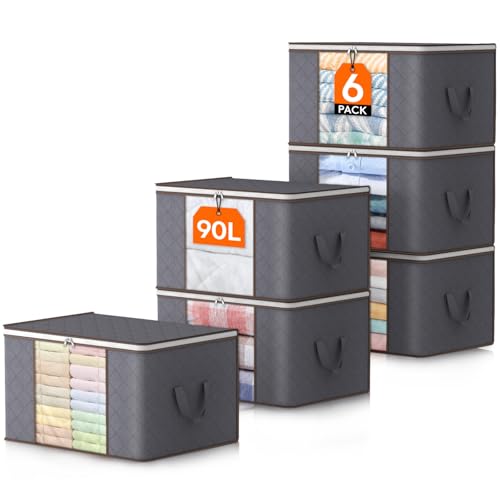
Lifewit 90L Aufbewahrungstasche Groß, Schrank Organizer Set 6 Stück
- Large Capacity: 90 liters per bag for bulky items
- Reinforced Handle: Sturdy handle with double-layer fabric
- Premium Material: Odorless, breathable, durable fabric with window
As an affiliate, we earn on qualifying purchases.
As an affiliate, we earn on qualifying purchases.
Key Questions
Which two decluttering rules does the report question?
It questions one in, one out, which pairs each new purchase with a discarded item, and the rule to let go of clothes not worn in a year.
What do organizers suggest instead of one in, one out?
Kenika Williams and Jayna Lattimore recommend not treating every purchase as a reason to purge. They point to regular clear-outs and making sure new items have a functional place at home.
How should I decide whether to keep clothes I rarely wear?
The organizers quoted suggest considering whether the item is special, works with other clothes and fits your current lifestyle. They do not set a universal limit or deadline.
Does the report say these rules never work?
No. Williams said one in, one out can be kept if it works for someone. The report presents alternatives to rigid use of the rules, not a claim that they are wrong for every household.
Source: rss