
TL;DR
House Beautiful reports on a decluttering method proposed by storage expert Max Wilson: give each item an everyday home, a seasonal home or an exit home. The approach is practical advice, not a formally tested method, and its success depends on choosing accessible storage and actually moving unwanted items out.
House Beautiful has outlined a three-category decluttering method from Max Wilson, CEO and co-founder of Pocket Storage, that assigns each possession an everyday home, a seasonal home or an exit home. The advice is intended to make it easier to decide where kept items belong and to move unwanted belongings out rather than leaving them in a new pile.
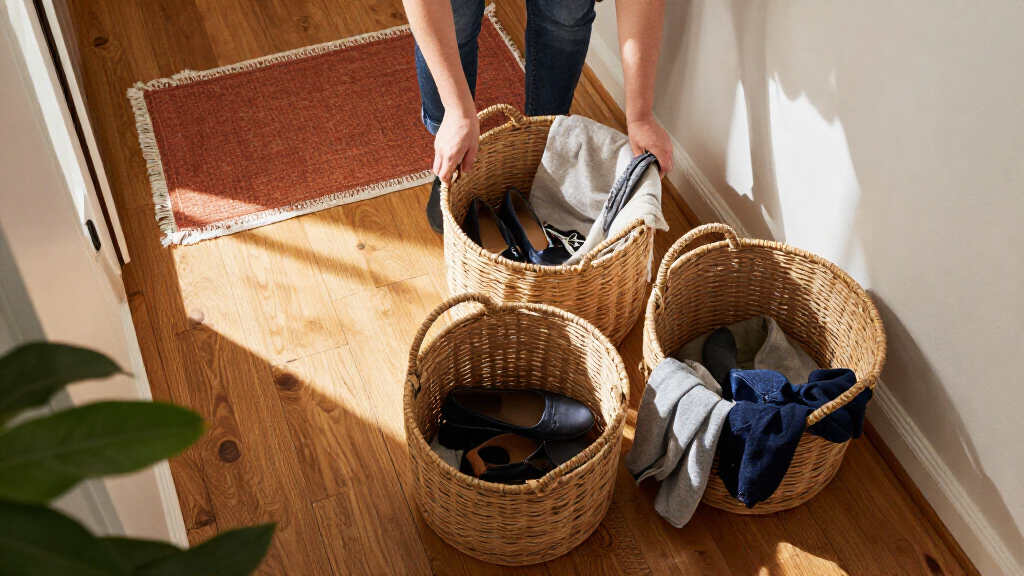
The method addresses two decisions that can make a clear-out feel difficult: what to keep and where to put it. Wilson recommends sorting one item at a time. Frequently used belongings should be stored close to where they are needed; things used only at certain times of year can be put away together; and anything no longer wanted should be assigned a route out of the home.
For the everyday category, Wilson advises choosing a convenient, specific spot. Examples in the House Beautiful report include coat hooks near the entrance, a bread bin in the kitchen, and accessible places for school bags, post or gym clothes. The idea is to make putting something away as straightforward as retrieving it, rather than requiring several steps.
The seasonal category is for things a household still needs but does not use regularly, such as camping equipment or seasonal clothing. Wilson recommends storing related items together and choosing a location suited to them. The exit category is a designated place for donations or other items to remove. The report stresses that this space should be temporary: setting a drop-off date or another clear next step helps prevent an exit pile from becoming more clutter.
A Clear Destination for Each Item
The method’s practical value is that it separates keeping an item from keeping it within easy reach. Belongings used daily can stay accessible without forcing less frequently used equipment into the same cupboards. Grouping seasonal items can also make it easier to find a complete set when it is needed.
It also makes the final stage of decluttering explicit. A bag marked for donation does not free space while it remains at home; the exit category needs a follow-through plan. For readers who get stuck between deciding to let something go and actually removing it, that distinction offers a concrete next action. The report does not provide evidence that the method has been tested or works for every household, so it is best understood as an organizing suggestion rather than a proven result.

6 Stück Kunststoff Aufbewahrungsboxen,Mehrere Farben Organisation Aufbewahrungskörbe für Küche,Schrank,Büro,Bad,Spielzeug,Home Tidy Open Storage Bins mit Griffen(3pcs 24×17.5×9.5cm + 3pcs 20x14x7cm)
- Set includes 6 storage boxes: Three 24×17.5×9.5cm and three 20x14x7cm
- Made from durable, high-quality plastic: Strong, bend-resistant, long-lasting material
- Vibrant multi-color design: Seven bright colors for organized styling
As an affiliate, we earn on qualifying purchases.
As an affiliate, we earn on qualifying purchases.
How the Three Categories Work
Wilson’s approach, as presented by House Beautiful, is built around assigning belongings according to how often they are used and whether they are still wanted. Everyday items go near their point of use; seasonal belongings are kept for later but stored out of the way; unwanted items are gathered for removal.
The examples in the report show how the same principle can apply across a home: frequently worn jackets can go on entryway hooks, while camping gear can be stored together until the next trip. Wilson cautions against keeping things solely because they might be useful someday, while recognizing that some infrequently used items are worth retaining. The report does not set a required storage size, timetable or disposal method; those choices depend on the items and household.
“Something you use most mornings shouldn’t require a small excavation.”
— Max Wilson, CEO and co-founder of Pocket Storage, as quoted by House Beautiful

4smile Türgarderobe zum Einhängen, Kleiderhaken Tür, Silber | Türhaken universell verwendbar, Vielseitige Haken zum Einhängen, platzsparende Türhakenleiste für gesamte Wohnung
- Material: Edelstahl for durability and style
- Versatile Use: Suitable for clothes, towels, and accessories
- Universal Fit: Fits all standard doors
As an affiliate, we earn on qualifying purchases.
As an affiliate, we earn on qualifying purchases.
Limits of the Organizing Advice
The source presents the three-homes rule as expert advice; it does not report research, measured results or comparisons with other decluttering methods. It is not clear how well the approach works across different home sizes, storage constraints or household routines.
The article also does not prescribe what to do with every type of unwanted item. Donation, resale, recycling and disposal may depend on condition, local services and the item itself. Wilson’s central recommendation is to decide on a route when placing something in the exit category, but the report does not give a universal deadline for completing that step.

15 Fächer Innentasche für Handtaschen Organizer mit Kleingeldbörse, Schwarz
- Schnelles Finden von Gegenständen: 15 Fächer für schnelle Übersicht
- Formstabil für Ihre Tasche: Hält Tasche in schöner Form
- Leicht und langlebig: Nylon außen, Polyester innen
As an affiliate, we earn on qualifying purchases.
As an affiliate, we earn on qualifying purchases.
Put the Sorting Plan Into Practice
Readers applying the method can start with a small area and give each item one of the three destinations: an accessible everyday spot, grouped seasonal storage or a defined exit route. For seasonal belongings, the next useful check is whether the items are stored together and in a location appropriate to their needs.
For anything set aside to leave, choose a specific action—such as arranging a donation drop-off—rather than letting the pile sit indefinitely. House Beautiful’s report offers no announced follow-up or formal next milestone; the outcome depends on how consistently households use the categories and complete the removal step.

DIFULI 2 x 3.7 L Waschmittel Aufbewahrung mit Bambusdeckel, Waschmittelbox mit 2 Messlöffeln, Stift & 24 Etiketten, für Waschpulver, Waschmittel Pods, Wäscheparfüm & Spülmaschinentabs
- Large Capacity Containers: 2 x 3.7 L for ample storage
- Includes Measuring Tools: 2 measuring spoons, 1 marker, 24 labels
- Transparent Design: Easily see contents without opening
As an affiliate, we earn on qualifying purchases.
As an affiliate, we earn on qualifying purchases.
Key Questions
What is the three-homes rule?
It is a decluttering approach described by House Beautiful in which each item is assigned an everyday home, seasonal home or exit home, depending on how often it is used and whether it is still wanted.
What belongs in an everyday home?
Items used regularly belong in a convenient place near where they are used. The report gives examples such as frequently worn coats on hooks by the door and a bread bin in the kitchen.
How should seasonal belongings be stored?
Keep items used at certain times of year together so they can be found as a group, Wilson advises. Choose a location that suits the belongings, rather than mixing them into an unlabeled box of unrelated items.
How do you stop an exit home becoming another clutter pile?
Decide what will happen to items when they are placed there, such as scheduling a donation drop-off. Wilson’s advice is that unwanted belongings do not free space until they actually leave the home.
Is the three-homes rule scientifically tested?
The House Beautiful report presents it as advice from a storage expert. It does not cite studies or measured outcomes showing how effective the method is.
Source: rss